Reading Market Sentiment: Fear, Greed and Why It Matters
Markets are moved by emotion. How the Fear & Greed framework measures sentiment, the contrarian logic behind it, and why it's a context tool — never a timing signal.

Key takeaways
- Market sentiment is the overall attitude of investors toward an asset or market at a given moment.
- One of the most widely followed gauges distils sentiment into a single number on a scale from extreme fear to extreme greed.
- The classic interpretation is contrarian, captured by the old line about being “fearful when others are greedy and greedy when others are fearful.” The reasoning: by the time everyone is euphoric, muc…
- Sentiment indicators are a window into the crowd’s mood, and the crowd’s mood genuinely moves markets — across both crypto and equities, which often feel fear and greed in unison.
- Sentiment indicators are a window into the crowd’s mood, and the crowd’s mood genuinely moves markets — across both crypto and equities, which often feel fear and greed in unison.
Markets are made of numbers, but they are moved by emotions. Prices reflect millions of people acting on hope, fear, conviction and panic — and when those feelings cluster, they leave fingerprints you can actually measure. Sentiment indicators try to read that collective mood. Used well, they add a useful layer of context; used badly, they become just another way to chase the crowd.
What “sentiment” means
Market sentiment is the overall attitude of investors toward an asset or market at a given moment. It is not about what the fundamentals say a thing is worth; it is about how people feel regarding where the price is going. Extreme optimism and extreme pessimism both tend to push prices away from what cooler analysis would justify — which is exactly why sentiment is worth watching.
The Fear & Greed framework
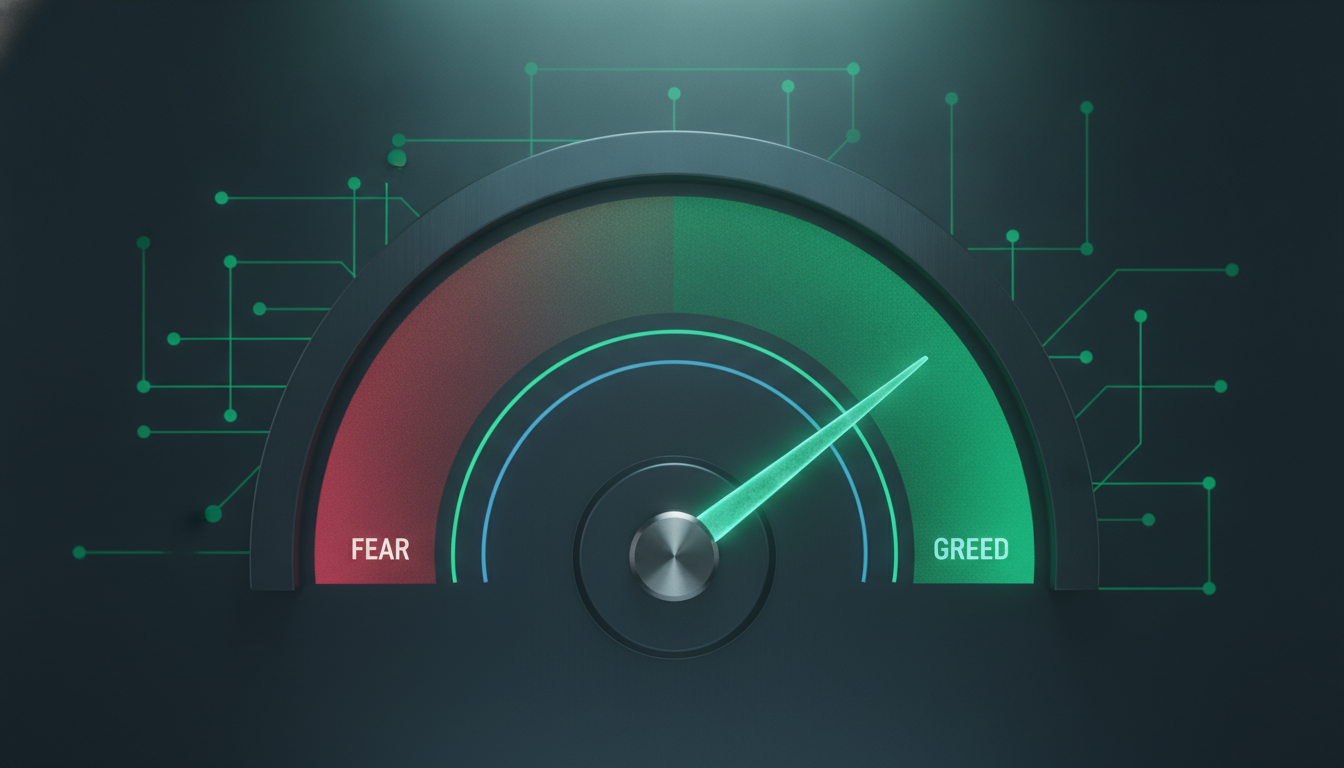
One of the most widely followed gauges distils sentiment into a single number on a scale from extreme fear to extreme greed. It blends several inputs — volatility, momentum, the direction of recent moves, and survey-style signals — into one reading. When the dial sits in “extreme greed,” it suggests the market may be running hot on optimism. When it plunges into “extreme fear,” pessimism may be overdone. You can see the live crypto reading on our Fear & Greed gauge.
The contrarian logic — and its limits
The classic interpretation is contrarian, captured by the old line about being “fearful when others are greedy and greedy when others are fearful.” The reasoning: by the time everyone is euphoric, much of the buying power is already spent; by the time everyone has capitulated, much of the selling is done. Extremes in sentiment can mark turning points.
But here is the essential caveat: sentiment is a context tool, not a timing machine. Markets can stay greedy — or fearful — for far longer than seems reasonable. “Extreme greed” is not a sell signal, and “extreme fear” is not a buy signal. These readings describe the emotional weather; they do not tell you the exact hour it will change. Acting mechanically on them is a fast way to be early, and being early can be indistinguishable from being wrong.
How to use it sensibly
- As a check on your own emotions. If the gauge screams greed and you feel an urge to pile in, that is worth a pause. Sentiment tools are often most valuable as a mirror.
- As one input among many. Combine it with fundamentals and your own plan — never as a standalone trigger.
- Alongside a real risk framework. Sentiment tells you nothing about how much to risk on any decision. That is what position sizing is for, and why steady approaches like dollar-cost averaging sidestep the timing trap altogether.
The takeaway
Sentiment indicators are a window into the crowd’s mood, and the crowd’s mood genuinely moves markets — across both crypto and equities, which often feel fear and greed in unison. Read them for perspective, let them temper your worst impulses, and resist the temptation to treat a number on a dial as a command. The market’s emotions are information; they are not instructions. Keep an eye on both markets together on our markets overview.
This article is general education, not investment advice. Nothing here is a recommendation to buy or sell any asset. Please read our full disclaimer.
A journalist with several years of experience in news and entertainment reporting, now writing a variety of articles on crypto, finance and markets. Based in New York.